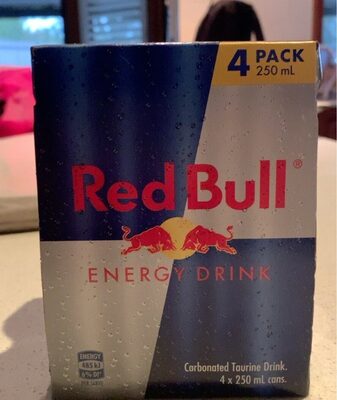

Redbull - Red bull - 4 x 250ml
This product page is not complete. You can help to complete it by editing it and adding more data from the photos we have, or by taking more photos using the app for Android or iPhone/iPad. Thank you!
×
Barcode: 9002490100759 (EAN / EAN-13)
Quantity: 4 x 250ml
Brands: Red bull
Categories: Beverages and beverages preparations, Beverages, Energy drinks, Sweetened beverages
Labels, certifications, awards: Pasteurized
Origin of ingredients: Austria
Stores: Woolworths, Coles, Officeworks
Countries where sold: Australia, New Zealand
Matching with your preferences
Health
Ingredients


Food processing
-

Ultra processed foods
Elements that indicate the product is in the 4 - Ultra processed food and drink products group:
- Additive: E101 - Riboflavin
- Ingredient: Colour
- Ingredient: Flavouring
- Ingredient: Glucose
Food products are classified into 4 groups according to their degree of processing:
- Unprocessed or minimally processed foods
- Processed culinary ingredients
- Processed foods
- Ultra processed foods
The determination of the group is based on the category of the product and on the ingredients it contains.
Additives
Ingredients analysis
-

Palm oil content unknown
Unrecognized ingredients: Caramel-1, Bo, Not-recommended-for-children, Laurine-pregnant-and-lactating-women-and-caffeine-sensitive-persons, Usage, 2-cans-max, Daily, Best-before-and-lot-id-see-base-of-canSome ingredients could not be recognized.
We need your help!
You can help us recognize more ingredients and better analyze the list of ingredients for this product and others:
- Edit this product page to correct spelling mistakes in the ingredients list, and/or to remove ingredients in other languages and sentences that are not related to the ingredients.
- Add new entries, synonyms or translations to our multilingual lists of ingredients, ingredient processing methods, and labels.
If you would like to help, join the #ingredients channel on our Slack discussion space and/or learn about ingredients analysis on our wiki. Thank you!
-

Vegan status unknown
Unrecognized ingredients: Caramel-1, Bo, Vitamin b12, Not-recommended-for-children, Laurine-pregnant-and-lactating-women-and-caffeine-sensitive-persons, Usage, 2-cans-max, Daily, Best-before-and-lot-id-see-base-of-canSome ingredients could not be recognized.
We need your help!
You can help us recognize more ingredients and better analyze the list of ingredients for this product and others:
- Edit this product page to correct spelling mistakes in the ingredients list, and/or to remove ingredients in other languages and sentences that are not related to the ingredients.
- Add new entries, synonyms or translations to our multilingual lists of ingredients, ingredient processing methods, and labels.
If you would like to help, join the #ingredients channel on our Slack discussion space and/or learn about ingredients analysis on our wiki. Thank you!
-

Vegetarian status unknown
Unrecognized ingredients: Caramel-1, Bo, Vitamin b12, Not-recommended-for-children, Laurine-pregnant-and-lactating-women-and-caffeine-sensitive-persons, Usage, 2-cans-max, Daily, Best-before-and-lot-id-see-base-of-canSome ingredients could not be recognized.
We need your help!
You can help us recognize more ingredients and better analyze the list of ingredients for this product and others:
- Edit this product page to correct spelling mistakes in the ingredients list, and/or to remove ingredients in other languages and sentences that are not related to the ingredients.
- Add new entries, synonyms or translations to our multilingual lists of ingredients, ingredient processing methods, and labels.
If you would like to help, join the #ingredients channel on our Slack discussion space and/or learn about ingredients analysis on our wiki. Thank you!
-

Details of the analysis of the ingredients
We need your help!
Some ingredients could not be recognized.
We need your help!
You can help us recognize more ingredients and better analyze the list of ingredients for this product and others:
- Edit this product page to correct spelling mistakes in the ingredients list, and/or to remove ingredients in other languages and sentences that are not related to the ingredients.
- Add new entries, synonyms or translations to our multilingual lists of ingredients, ingredient processing methods, and labels.
If you would like to help, join the #ingredients channel on our Slack discussion space and/or learn about ingredients analysis on our wiki. Thank you!
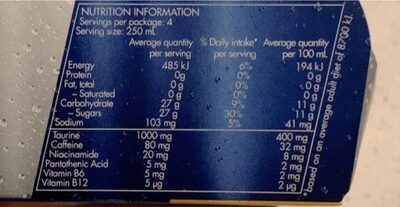
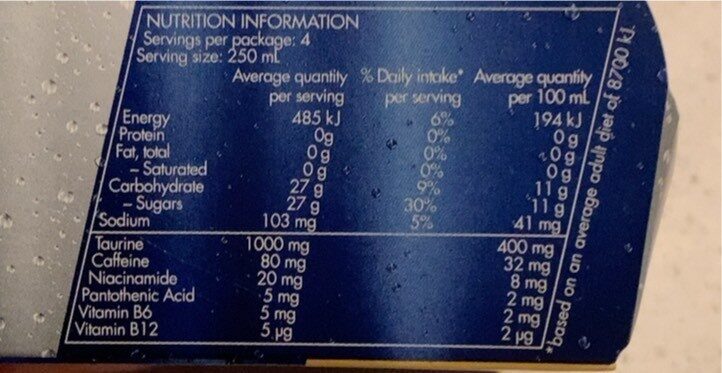
en: Carbonated water, sucrose, glucose, acidity regulator (citric acid, sodium bicarbonate, magnesium carbonate), flavours, colours (caramel 1, riboflavin), caffeine 0.03%, vitamins (niacinamide, pantothenic acid, bó, b12), contains caffeine, not recommended for children, laurine pregnant and lactating women and caffeine sensitive persons, usage (2 cans max), daily, best before and lot id-see base of can- Carbonated water -> en:carbonated-water - vegan: yes - vegetarian: yes - ciqual_food_code: 18066 - percent_min: 57.36 - percent_max: 99.82
- sucrose -> en:sucrose - vegan: yes - vegetarian: yes - ciqual_proxy_food_code: 31016 - percent_min: 0.03 - percent_max: 10.8
- glucose -> en:glucose - vegan: yes - vegetarian: yes - ciqual_proxy_food_code: 31016 - percent_min: 0.03 - percent_max: 10.8
- acidity regulator -> en:acidity-regulator - percent_min: 0.03 - percent_max: 10.8
- citric acid -> en:e330 - vegan: yes - vegetarian: yes - percent_min: 0 - percent_max: 10.8
- sodium bicarbonate -> en:e500ii - vegan: yes - vegetarian: yes - percent_min: 0 - percent_max: 5.4
- magnesium carbonate -> en:e504i - vegan: yes - vegetarian: yes - percent_min: 0 - percent_max: 3.6
- flavours -> en:flavouring - vegan: maybe - vegetarian: maybe - percent_min: 0.03 - percent_max: 5
- colours -> en:colour - percent_min: 0.03 - percent_max: 5
- caramel 1 -> en:caramel-1 - percent_min: 0 - percent_max: 5
- riboflavin -> en:e101 - vegan: maybe - vegetarian: yes - percent_min: 0 - percent_max: 2.5
- caffeine -> en:caffeine - vegan: yes - vegetarian: yes - percent_min: 0.03 - percent: 0.03 - percent_max: 0.03
- vitamins -> en:vitamins - vegan: yes - vegetarian: yes - percent_min: 0 - percent_max: 0.03
- niacinamide -> en:e375 - vegan: maybe - vegetarian: maybe - percent_min: 0 - percent_max: 0.03
- pantothenic acid -> en:pantothenic-acid - vegan: yes - vegetarian: yes - percent_min: 0 - percent_max: 0.03
- bó -> en:bo - percent_min: 0 - percent_max: 0.03
- b12 -> en:vitamin-b12 - percent_min: 0 - percent_max: 0.03
- contains caffeine -> en:caffeine - vegan: yes - vegetarian: yes - percent_min: 0 - percent_max: 0.03
- not recommended for children -> en:not-recommended-for-children - percent_min: 0 - percent_max: 0.03
- laurine pregnant and lactating women and caffeine sensitive persons -> en:laurine-pregnant-and-lactating-women-and-caffeine-sensitive-persons - percent_min: 0 - percent_max: 0.03
- usage -> en:usage - percent_min: 0 - percent_max: 0.03
- 2 cans max -> en:2-cans-max - percent_min: 0 - percent_max: 0.03
- daily -> en:daily - percent_min: 0 - percent_max: 0.03
- best before and lot id-see base of can -> en:best-before-and-lot-id-see-base-of-can - percent_min: 0 - percent_max: 0.03
Nutrition
-
Missing data to compute the Nutri-Score
Missing nutrition facts
⚠ ️The nutrition facts of the product must be specified in order to compute the Nutri-Score.Could you add the information needed to compute the Nutri-Score? Add nutrition facts
-

Nutrient levels
-

Fat in low quantity (0%)
What you need to know- A high consumption of fat, especially saturated fats, can raise cholesterol, which increases the risk of heart diseases.
Recommendation: Limit the consumption of fat and saturated fat- Choose products with lower fat and saturated fat content.
-
Saturated fat in low quantity (0%)
What you need to know- A high consumption of fat, especially saturated fats, can raise cholesterol, which increases the risk of heart diseases.
Recommendation: Limit the consumption of fat and saturated fat- Choose products with lower fat and saturated fat content.
-

Sugars in high quantity (10.8%)
What you need to know- A high consumption of sugar can cause weight gain and tooth decay. It also augments the risk of type 2 diabetes and cardio-vascular diseases.
Recommendation: Limit the consumption of sugar and sugary drinks- Sugary drinks (such as sodas, fruit beverages, and fruit juices and nectars) should be limited as much as possible (no more than 1 glass a day).
- Choose products with lower sugar content and reduce the consumption of products with added sugars.
-

Environment
-

Eco-Score not yet applicable
Not yet applicable for the category: Energy drinks
The Eco-Score is not yet applicable for this category, but we are working on adding support for it.
Packaging
-

Missing packaging information for this product
⚠ ️ The information about the packaging of this product is not filled in.Take a photo of the recycling information Take a photo of the recycling information
Transportation
-

Origins of ingredients
Origins of ingredients with a high impact
Origin of the product and/or its ingredients % of ingredients Impact Austria 100 %Medium

Data sources
Product added on by openfoodfacts-contributors
Last edit of product page on by lcmortensen.
Product page also edited by archanox, ecoscore-impact-estimator, inf, kiliweb, yuka.sY2b0xO6T85zoF3NwEKvlnxVAvvanD_ZKjL4uWPRw_WpBIbVZtNWs9PdKas.